

Former CDC director Tom Frieden and colleagues recently published a JAMA opinion piece condemning the CDC vaccine advisory committee’s endorsement of “shared decision-making” for future Covid-19 boosters.
They argued the shift was an ethical lapse — even an “abdication of responsibility” — particularly for older adults.

But what the CDC’s Advisory Committee on Immunization Practices (ACIP) proposed was nothing radical. It was the same patient-centred model that should be used across modern medicine.
Which is why the establishment’s reaction is so revealing: the moment the subject is “vaccination,” even the most basic principles of transparency and informed consent are treated as optional — or worse, as threats.
What ACIP Is Actually Proposing
In September, ACIP recommended that Covid-19 shots should no longer be a blanket policy but instead be decided through shared decision-making.
For older adults and those with underlying conditions, this meant discussing risks, benefits, and uncertainties with their doctors — and making a personalised choice.
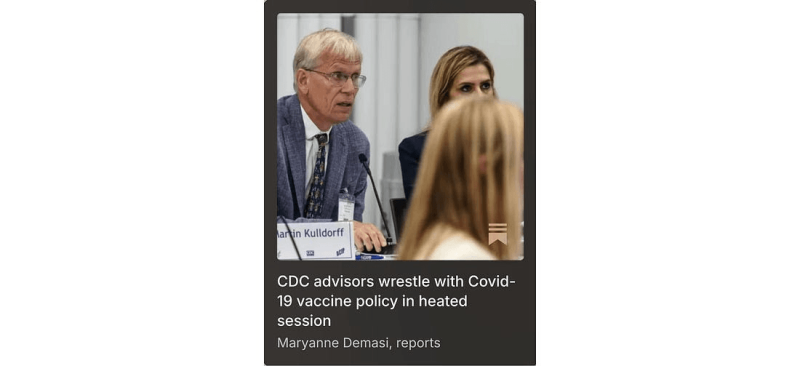
This should be standard practice in nearly every other clinical scenario — prostate cancer screening, hormone therapy, antidepressant use in pregnancy, or cardiac surgery.
But vaccines have been placed on a pedestal. Questioning, hesitating, or individualising the decision has been treated as heresy.
The unspoken rule is that both doctors and patients must “trust the science,” even when the science is evolving, and individual circumstances differ.
In that climate, ACIP’s recommendation wasn’t received as a return to ethical practice. It was seen as a direct challenge to a decades-old orthodoxy built on the idea that vaccine decisions are too sacred to be personalised.
The Claim That “Ambiguity Does Not Exist”
Frieden and colleagues insist that for older adults, the benefit–risk calculus is so clear that “ambiguity does not exist,” making individualised conversations not just unnecessary but potentially harmful.
They also warn that leaving such decisions to clinicians and patients creates a “vacuum” that other professional groups will rush to fill.
To defend the claim that there is no ambiguity in the benefit of Covid boosters for older adults, they rely heavily on observational data, including a 2025 Veterans study of 160,000 people reporting modest reductions in hospitalisation and death among boosted recipients.
But like all observational research, the data have serious limitations.
The cohort was anything but uniform: different infection histories, different numbers of prior doses, and a high burden of chronic illness that elevates baseline risk regardless of vaccination.
“Real-world” data can offer insights, but it also carries real-world flaws — and it is not a sound basis for shutting down clinical dialogue.
A Shaky Analogy
The authors go further, suggesting that the benefits of Covid boosters for older adults are as absolute as vitamin K prophylaxis for newborns.
But equating a one-off, decades-validated intervention with repeated dosing of a novel mRNA platform in a highly variable adult population is scientifically and ethically indefensible.
Vitamin K is predictable, durable, and biologically straightforward.
Covid boosters operate in a shifting landscape: an evolved virus, continually updated formulations, divergent exposure histories, and dramatically reduced baseline risk.
The analogy works only if vaccines are treated as uniquely simple interventions — when in reality they involve far more complexity, uncertainty, and individual variation.
Why Conversation Is Not “Abdication”
At the heart of the authors’ critique is the claim that ACIP “abdicates responsibility” by letting doctors and patients decide.
But that is the very purpose of medicine: to move away from paternalism and toward transparent presentation of evidence — a process that strengthens, not weakens, the relationship between doctor and patient.
Shared decision-making requires time, honesty, and respect. It ensures that even when the evidence is strong, patients understand the trade-offs and can choose according to their own values.
Ironically, Frieden and colleagues support this model in other contexts, such as prostate cancer screening, where no single “best choice” exists.
But when the discussion turns to vaccines, transparent conversations suddenly become dubious?
The issue is not the strength of the evidence. It is the cultural expectation that vaccine decisions should be insulated from personal preference — an expectation that has no place in ethical medical practice.
The Ethics of Informed Consent
Ethical standards should not shift depending on the intervention. Either informed consent applies to all medical treatments — including vaccines — or it is meaningless.
Frieden and co-authors also claim that “all vaccines are given only after informed consent,” a statement that bears little resemblance to many people’s lived experience.
Millions were coerced, mandated, or pressured into receiving vaccines they did not want — sometimes under threat of job loss, exclusion from education or restrictions on daily life.
Even pro-vaccine ethicists acknowledge that the US has no meaningful informed-consent process for vaccines.
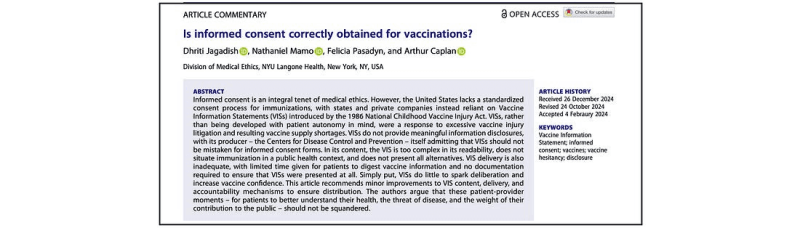
A 2024 commentary by ethicists at NYU Langone Health conceded that the CDC’s consent form (Vaccine Information Statement) “does not provide the understanding” required for informed consent and is often handed out after the injection.
And the CDC’s own actions last week demonstrate why honesty matters.
The agency quietly revised its autism guidance and acknowledged that its long-standing “vaccines do not cause autism” claim was “not evidence-based” because studies “have not ruled out” a possible link for vaccines given in early infancy.

This wasn’t a step backwards; it was a rare act of institutional honesty that restores trust, not undermines it.
The old habit of projecting absolute certainty onto complex questions — the habit Frieden now wants to preserve for Covid boosters — is precisely what damages trust and shuts down informed decision-making.
It leaves clinicians unable to speak plainly and patients unable to choose.
To me, that is the real abdication of responsibility. Informed consent is not a box to tick; it’s the foundation of trust between doctor and patient.
Health Care Workers Are Not Convinced
The notion that patients cannot be trusted with vaccination decisions reflects a deeper belief that vaccines occupy sacred territory, somehow exempt from the norms of medical practice.
ACIP’s recommendation for shared decision-making on Covid boosters is one of the first meaningful departures from that mindset.
And healthcare workers themselves have already delivered a verdict. According to the CDC’s own data, fewer than 10% received a booster in the past year.
These are professionals with privileged access to data and daily exposure to Covid outcomes. If prior CDC leadership could not convince its own workforce, a return to mandates and moralising will not shift public opinion.
Trust Built on Honesty, Not Authority
There is a legitimate debate to be had about how best to protect older and medically vulnerable people from Covid in the years ahead.
But dismissing shared decision-making as an “abdication of responsibility” implies something else: that vaccination is too important to be left to personal choice, and that conversation itself is risky because it might lead to disagreement.
Outside of true life-saving emergencies, shared decision-making must be the default — not something officials discard when they want to push the population toward a particular policy goal.
We tried the coercive model during the pandemic, and it triggered the largest collapse in public trust in modern medical history.
If public health wants to regain credibility, it must stop treating vaccination as a protected category exempt from normal ethical standards.
Every medical decision begins with a conversation — and it seems ACIP is pointing back in that direction.
Republished from the author’s Substack
Join the conversation:

Published under a Creative Commons Attribution 4.0 International License
For reprints, please set the canonical link back to the original Brownstone Institute Article and Author.